
Higher Education Allocation: A high-return, Long-term Investment

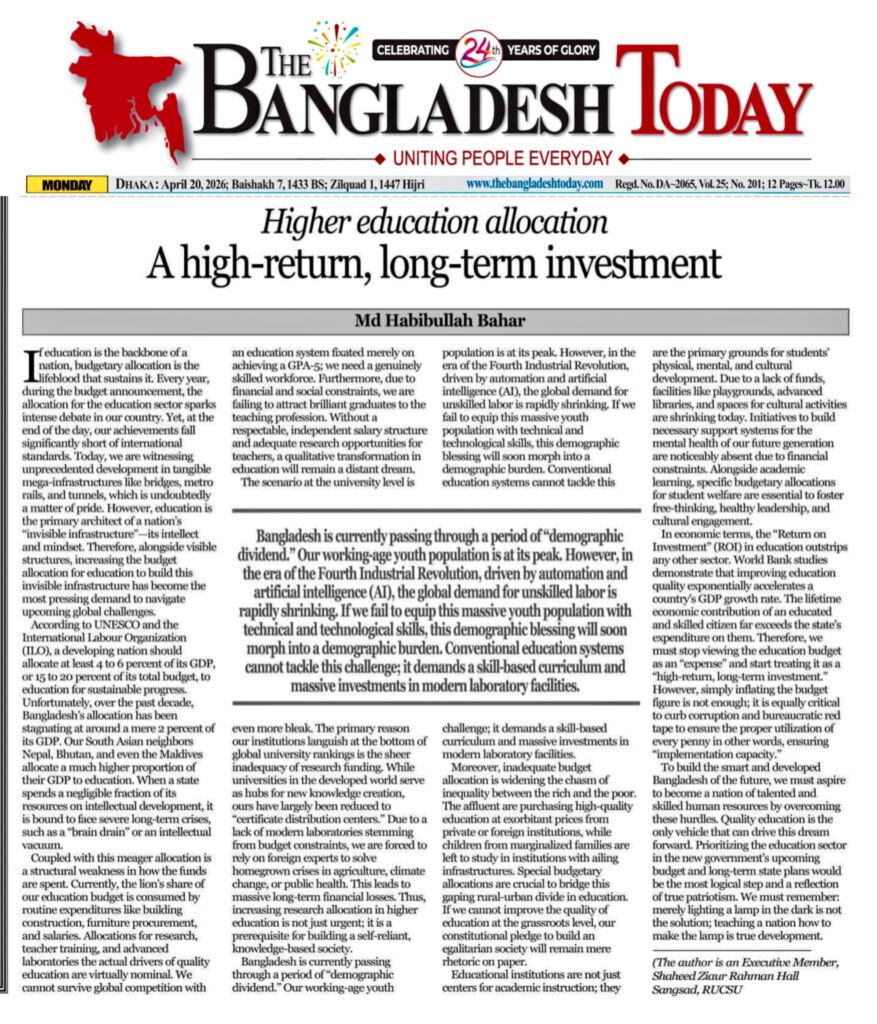
Higher education allocation: A high-return, long-term investment**
(Published,Bangladesh Today-20 Apr. 2026)
If education is the backbone of a nation, budgetary allocation is the lifeblood that sustains it. Every year, during the budget announcement, the allocation for the education sector sparks intense debate in our country. Yet, at the end of the day, our achievements fall significantly short of international standards. Today, we are witnessing unprecedented development in tangible mega-infrastructures like bridges, metro rails, and tunnels, which is undoubtedly a matter of pride. However, education is the primary architect of a nation’s “invisible infrastructure” its intellect and mindset. Therefore, alongside visible structures, increasing the budget allocation for education to build this invisible infrastructure has become the most pressing demand to navigate upcoming global challenges.
According to UNESCO and the International Labour Organization (ILO), a developing nation should allocate at least 4 to 6 percent of its GDP, or 15 to 20 percent of its total budget, to education for sustainable progress. Unfortunately, over the past decade, Bangladesh’s allocation has been stagnating at around a mere 2 percent of its GDP. Our South Asian neighbors Nepal, Bhutan, and even the Maldives allocate a much higher proportion of their GDP to education. When a state spends a negligible fraction of its resources on intellectual development, it is bound to face severe long-term crises, such as a “brain drain” or an intellectual vacuum.
Coupled with this meager allocation is a structural weakness in how the funds are spent. Currently, the lion’s share of our education budget is consumed by routine expenditures like building construction, furniture procurement, and salaries. Allocations for research, teacher training, and advanced laboratories the actual drivers of quality education are virtually nominal. We cannot survive global competition with an education system fixated merely on achieving a GPA-5; we need a genuinely skilled workforce. Furthermore, due to financial and social constraints, we are failing to attract brilliant graduates to the teaching profession. Without a respectable, independent salary structure and adequate research opportunities for teachers, a qualitative transformation in education will remain a distant dream.
The scenario at the university level is even more bleak. The primary reason our institutions languish at the bottom of global university rankings is the sheer inadequacy of research funding. While universities in the developed world serve as hubs for new knowledge creation, ours have largely been reduced to “certificate distribution centers.” Due to a lack of modern laboratories stemming from budget constraints, we are forced to rely on foreign experts to solve homegrown crises in agriculture, climate change, or public health. This leads to massive long-term financial losses. Thus, increasing research allocation in higher education is not just urgent; it is a prerequisite for building a self-reliant, knowledge-based society.
Bangladesh is currently passing through a period of “demographic dividend.” Our working-age youth population is at its peak. However, in the era of the Fourth Industrial Revolution, driven by automation and artificial intelligence (AI), the global demand for unskilled labor is rapidly shrinking. If we fail to equip this massive youth population with technical and technological skills, this demographic blessing will soon morph into a demographic burden. Conventional education systems cannot tackle this challenge; it demands a skill-based curriculum and massive investments in modern laboratory facilities.
Moreover, inadequate budget allocation is widening the chasm of inequality between the rich and the poor. The affluent are purchasing high-quality education at exorbitant prices from private or foreign institutions, while children from marginalized families are left to study in institutions with ailing infrastructures. Special budgetary allocations are crucial to bridge this gaping rural-urban divide in education. If we cannot improve the quality of education at the grassroots level, our constitutional pledge to build an egalitarian society will remain mere rhetoric on paper.
Educational institutions are not just centers for academic instruction; they are the primary grounds for students’ physical, mental, and cultural development. Due to a lack of funds, facilities like playgrounds, advanced libraries, and spaces for cultural activities are shrinking today. Initiatives to build necessary support systems for the mental health of our future generation are noticeably absent due to financial constraints. Alongside academic learning, specific budgetary allocations for student welfare are essential to foster free-thinking, healthy leadership, and cultural engagement.
In economic terms, the “Return on Investment” (ROI) in education outstrips any other sector. World Bank studies demonstrate that improving education quality exponentially accelerates a country’s GDP growth rate. The lifetime economic contribution of an educated and skilled citizen far exceeds the state’s expenditure on them. Therefore, we must stop viewing the education budget as an “expense” and start treating it as a “high-return, long-term investment.” However, simply inflating the budget figure is not enough; it is equally critical to curb corruption and bureaucratic red tape to ensure the proper utilization of every penny in other words, ensuring “implementation capacity.”
To build the smart and developed Bangladesh of the future, we must aspire to become a nation of talented and skilled human resources by overcoming these hurdles. Quality education is the only vehicle that can drive this dream forward. Prioritizing the education sector in the new government’s upcoming budget and long-term state plans would be the most logical step and a reflection of true patriotism. We must remember: merely lighting a lamp in the dark is not the solution; teaching a nation how to make the lamp is true development.
Md Habibullah Bahar,Executive Member, Shaheed Ziaur Rahman Hall Sangsad, RUCSU.